Showing posts with label Mental Health stigma. Show all posts

Monday, 7 October 2019

The Waiting Game

I'm not a patient person. As I have learned to manage my emotional storms, I'm realising I am an ultimate optimist. If I believe something needs to be said or done to change a situation I want to immediately act to do that. Since 2010, following my diagnosis and entering the wonderful world of mental health services, so much of my life suddenly spun out of my control. I could try to give my perspective on why so much of my experience of waiting has been linked to going on a list to be assessed for suitability for 'treatment' but I don't think or believe that it helps to identify factors that are beyond my control.

Recently I've experienced the same frustrations while waiting for assessment of a physical problem. It has given me pause to consider the things that I do which make that waiting time either painful or bearable for me. There is something in the power of my thinking to either make time seem like eternity or go quicker than I expected. I've realised that rather than being powerless during these times, I can control those things which I have control of. I've recognised a number of ways that I have been able to manage these times better than in the past.

1. EXPECTATIONS. There is nothing worse than time on my hands to make my mind increase or decrease the importance of small things to the final outcome when whatever I am waiting for arrives. If I have waited for two years for 'treatment' the importance I place on that longed for appointment becomes enormous in comparison to the what the human being behind the date is able to deliver. I think this is the most important element to manage so that long waiting times do not become a matter of gambling with how quickly my initial presentation at assessment may deteriorate. Too often waiting periods end up being shortened due to lapse into crisis. Sometimes my self harming behaviour is a way of short-circuiting the process because I feel that if I go on feeling this way much longer, I will literally die. I need some help to get through the heights of emotional pain, so that each of those moments is not necessarily going to end up with an inpatient admission. I need help to create in my own environment a safe place to wait. I wonder if equipping me again becomes part of the triage and assessment stage? This could mean that I don't have an assessment appointment followed by between six months and two years of nothing. THAT feels like I'm in limbo, abandoned, in no mans' land, helpless and more importantly as waiting magnifies my negative thoughts and feelings: not worthy of help.

I wonder if, while waiting for specialist service appointments, there is scope for equipping people with self management and distress management skills. Mindfulness which was core to my DBT therapy has been so helpful in so many waiting times for me. Could it be useful as a tool, among others, to help people manage the time spent waiting (given that the prevailing economic and political realities prevent these times from shortening in the short term.)?

I have noticed that when I break a leg or an arm, while I am waiting for the orthopaedic specialists the emergency staff have measures to support the broken bones, and alleviate the physical pain. Of course no one can remove from me the emotional pain and distress I am experiencing, even when I end up before the professional I have been referred to. No one can fix me. No one can undo my past traumas. No one can stop me feeling this lousy. BUT I can be helped to learn to manage such pain and distress in less self-destructive ways. Can I be offered some first aid for my emotions which can hold me while I wait?

2. PERSPECTIVES. My feelings and their imbalance within me cause my perspectives on the world around me to become skewed. Given the extent of my distress small things had huge impacts on my mental health. I tried two different interventions and waited 18 months before I started my DBT journey. During the time between diagnosis and about six months in the DBT programme I was still trying to remain in my demanding job. My perspective on waiting for treatment and starting treatment was heavily influenced by the sickness procedures which seemed to place some kind of magical aura on the idea that I had started being 'treated' for my 'condition'. The expectation became that because I had two days off a week to attend my group skills and individual therapy, then there should be no further issues from my mental health that would affect my work. In other words, having supported me during the waiting time, my employers then expected me to be magically 'fixed', ignoring the fact that my long term mental health struggles would require long term management, including re-learning how to adapt myself to any work environments, without ending up emotionally exhausted.

If we see our struggles with mental health as tackling pathogens, then we will end up having major conflicts between the needs of people using services and, particularly the medically trained professionals who determine pathways. I WILL blame you if you do not 'cure' me, you WILL blame me if your medications or treatments are not as effective as you had hoped. So many times during my experiences of different interventions I was told I had not made the most of the help on offer. DBT was the first time I was told that if I was not making progress then we needed to review how suitable the intervention was for me.

Another aspect, particularly when waiting and expecting the magic bullet of 'help' is time itself. I had experienced significant trauma from early childhood right up to leaving home at 18. Then again as an adult I experienced rape and sexual assault on two other occasions (as a woman there were other lesser assaults which were just part and parcel of life in the 80s and 90s), last being when I was 40. I was diagnosed with BPD (Borderline PD) at the age of 42 although I had been through many experiences with Psychiatrists, Psychologists, Counsellors of various shades and theories from the age of 15. It is now ten years since my diagnosis. Only five of those years involved regular contact with Mental Health Practitioners. In pure terms of number of hours spent with those practitioners compared to the number of years of turbulence and unhelpful coping methods, including self harm and self destructive behaviours. Given this, it would truly be miraculous if any Mental Health Practitioner was able to 'fix' the impact of so much trauma in my life. If during the time I have to wait for a first appointment I can be prepared to recognise these realities and to accept that, at best, I will have the support and expertise of someone to walk alongside me for a time as I begin to learn new ways of coping.

3. TIME. There is something in our culture at the moment which seems to encourage us all to wish our lives away. How many of us set our sights on our next break from work, be that the weekend or our next holiday. When I am struggling most, I find it easiest to live one day at a time. I have to. I don't have the emotional capacity to imagine or hope for more than one day at a time. When I have been at that stage, I have taught myself to look at moments as more significant than something to be endured while I wait for something in the distant future. If I can focus on each moment as a span of time which I can experience fully, either to be enjoyed or endured, then I know I can survive. And as things improve, those moments begin to lengthen until I can imagine myself engaging in life more than a day at a time.

4. RUNNING AHEAD OF MYSELF. One of the hardest things I face during recovery is my impatience to get to some goal or other. At the moment I am tired of not being able to negotiate the complexities of returning to paid employment. I am managing my condition, but I don't know yet if I am ready for increased hours and pressure yet. Most of all I find the temporary nature of so much of the voluntary work I'm involved in difficult to manage, apart from the uncertainty thrown in every 18 months of having my benefits reviewed. I find the system itself is a major hurdle to negotiate to try to build up paid work. Most of all I face tremendous stigma based simply on the diagnosis I received, having worked successfully in some challenging areas. I have found with small projects and part time work, once I have reached interview or even people have seen me in action, there is usually no problem with my suitability. Sadly for the first time in my life I find that the thing which gives me added experience and expertise in working with people with complex needs, something I previously had paper qualifications and work experience for, means that my application is likely to end up in the bin, without me even being considered a serious contender. This puts a pressure on to prove myself to people who have a skewed view of Mental illness and PD in particular. So, I find myself wanting to change the universe in order to push deadlines which I know are immovable. I cannot make Christmas Day move forward from 25th December if I simply put my tree and lights up. I cannot make Colleges and Universities or potential employers change their admission/application times or procedures. Ultimately, I cannot know if I am ready for more hours of work, until someone gives me a chance. Until then I need to accept that there is a lot about the world of work and attitudes of employers to mental health that I cannot change.


Ultimately, time spent waiting can either be painful and feel like time wasted, or I can try to redeem the time:

- by not focusing on the event, appointment or occasions I am waiting for.
- It helps to go back to basics and try to live one day at a time.
- To admit when the environment is too difficult for me to change.
- To accept that moaning and allowing myself to stoke feelings of anticipation and anxiety will only make the passage of time feel as if it is slowing.
- To notice the positive things about having this time to work on things I rarely have time to work on...such as my yard, my dog, my fitness.

Monday, 9 January 2017

Taking the 'PIP' (part 2 - My New Life on the Rubbish Heap)

In the past two months I have had my income slashed by 2/3. Let that sink in. I have been assessed by the DWP as being unable to return to paid work due to the impact of my condition. But the same department have decided that I am not sufficiently incapable that I require any additional help with my living costs. So, I am adjusting to having £80 a month to live off after I have paid my housing and essential costs. I do not drink alcohol, I don't smoke. I have disposed of the vehicle which was helping me to volunteer and visit important friends once or twice a week. I am no longer able to afford the cost of swimming which was part of a plan agreed with my support worker to help me keep well. The council funding which would have supported projects open to people on limited incomes has been slashed. Opportunities to develop social skills and help me overcome my depression and anxiety symptoms have now closed down.

I am tired of fighting this system. I am sick of hearing myself pretend that I am doing okay with it. I am sick of not being able to be positive about the prospect of maintaining my recovery because the system keeps kicking me down. All made worse by the speech making and promises about mental health. My response to Mrs May right at the moment on how to achieve a major step forward in helping those of us with mental health issues is: please provide an adequately qualified assessment of mental health conditions using those who have experience of the complexities inherent to decide how my condition affects me on a day to day basis.

You may detect from the tone of my opening paragraphs that I have failed (again) in my paper appeal against the wholesale loss of all disability related benefits which has stripped out two thirds of my income. I am now facing the prospect of having to present my case within a courtroom to a panel which will include a member of the judiciary.


The following is the basis on which my appeal failed (bearing in mind that I have been unable to cope with reading any correspondence from the DWP since last June, anything that I know has been filtered by my support worker, so I did not have the full impact of the decision):

1. Prior to the assessment, I had suffered a number of vomiting bouts related to anxiety and stress caused by the PIP process. I decided to take additional meds to ameliorate these symptoms so I would not be sanctioned for missing the appointment. This was cited as evidence that I was managing my symptoms. Despite obviously overdosing on a range of medication this was not recognised by the 'health professional' or the faceless and nameless assessor at the DWP. This betrays a significant lack of medical knowledge related to the medication of complex co-morbidities related to BPD (Borderline Personality Disorder, aka Emotionally Sensitive PD).

2. Because I am intellectually capable of being able to read, interpret and use bus timetables, it was assessed that I do not struggle to use public transport. This is despite me explaining my experience of high levels of anxiety and inability to cope with large groups of people and sudden changes to timetables caused by road traffic incident, road works, etc.

3. The 'health professional' assessed that I was only affected by fluctuating moods on approximately 2-3 times a month. This directly contradicts the information I provided during the asssessment, or, indeed any rudimentary understanding of the major symptoms of ESPD. At the outset of the assessment interview I asked the assessor about his understanding of mood disorders in general and Personality Disorders in particular, he stated he had no experience of mental health, and none at all of PD. Given the complexity of diagnosis and the need for specialist intervention in order to accurately assess the groups of symptoms evident in ESPD, the PIP assessment is at best a blunt tool and at worst an actively vindictive weapon which effectively exacerbates the worst of my symptoms.

My overall observation of this assessment is that even for physical conditions it is rudimentary in the extreme. There is no scope for assessing those of us considered 'high-functioning', ie there is no method for assessing the emotional and mental impact of my mental health condition. It can only assess my intellectual capability which entirely misses the point of how mental health conditions affect people's ability to function on a day to day basis.

Overall my feelings at the moment are frustration and impotence. I know the progress I was making in trying to rebuild a life which allows me to manage the worst of my symptoms has been stopped in its tracks. Following the indifference and active anti-pathy towards the more vulnerable in society evident in our political leadership and rhetoric, I fear that I must become accustomed to my place on the rubbish heap of society. Simply because it seems that, at heart we, as voters will always put our own self interest ahead of everything else.

Monday, 19 September 2016

Words (and their impact on Recovery)

'The verb is 'to crown'!' As I write I am shouting at a journalist, supposedly an artful practitioner of our language, telling me that someone is on in the process of being 'coronated'! Grrrrr. I would not call myself a grammatical tyrant, but really folks, English is so difficult to learn as a foreign language, precisely because we can carefully choose the words we want to use in any given context. I used to liken grammar to a train. It makes sense if you label in a very specific way... anyway I'm not about to launch into a Year 7 parts of speech lesson, although I have had a hankering for teaching recently. Anyway, the main thrust for my imagery was to convey to the children that how we structure our words is vital to helping us become really good at communicating what is in our heads to the world around us.


Of course as we grow older we find that not only have we left the childish belief that 'words can never hurt me' behind us, but we realise there are certain words which not only convey an idea, but can be loaded with judgement. Words like, 'unemployed', 'mentally ill', 'immigrant'carry with them sometimes very dark judgements, mostly about people who have a different background or experience to us.

One thing I have noticed as I have continued on my recovery journey, is that I am now more sensitive to certain words and, as a result, they can have a devastating impact on my emotions, often triggering feelings of failure. Sometimes it's a single word, at others it's a well worn phrase, or a sentence. Here is a selection:

Relapse. When I was working with drug users in recovery there was much discussion around 'lapses' and 'relapses'. Our mantra was 'a lapse is not a relapse...' I have found that when I face struggles in recovery from my emotional issues everyone refers just to a 'relapse' which to me means failure, going back to square one, letting myself and everyone else down. One word, but so much weight of judgement. I have combatted this by dropping the 're' and saying to myself 'a lapse is not a relapse' A lapse means that I have been overwhelmed by a moment, it is a temporary setback, recoverable. I can reset myself from a lapse. To me, for a relapse to happen means I have needed more extensive outside help to recover from out of control emotions and/or I have reverted to using self defeating coping mechanisms. It may seem a small thing, but the addition of a prefix totally changes my reactions and/or actions to recover again.


Mental Illness/Condition/Issues: I could call what I battle with, 'bagel', that way I can totally avoid judgements being loaded on me by others who have interpreted what suffering from a Mental Health Condition means. The problem is that without giving you my history and context the word is out of place and therefore fails to convey the ideas I am seeking to communicate. Hence it is problematic if I launch into my story by telling you that 'I was diagnosed with 'bagel' in 2011'. Sometimes I have the choice to ignore other people's judgements and values applied to certain labels and choose to redefine them for myself. If I believe that mental health conditions are just the same as physical health conditions, then why wouldn't I be willing to use commonly used phrases which are basically descriptive. The best way to tackle stigma is to introduce the ignorant to human reality. It is powerful to stand in front of a room and be able to admit that I struggle with my emotions and sometimes my thinking becomes clouded as a result. Particularly in recovery this can be more productive for me than focusing on trying to change people's use of specific words - why not simply introduce them to the person they avoid behind the labels?

Vulnerable v Fragile. One thing I heard through the DBT (dialectical behaviour therapy) programme was that although I may be emotionally vulnerable at times, I am not fragile. There is a song by Julia Fordham called 'Porcelain' and it expresses that frustration women often have when treated as 'weak', needful of protection. I know there is a paradox here. It is nice to be looked after, to know that people care for our needs. I guess there is a line, maybe it's similar to the one some relationships cross when 'protective' becomes 'possessive'. There is a sense of smothering, of not being trusted to be an adult, a loss of independence. I think there is an element of seeing patients as 'fragile' which contributes to the environments in Mental Health services which create dependence and that thorny little issue of 'learned helplessness'. Granted there are times when it would lovely to have a white knight swoop me up into his strong arms while he whisks me away from my daily grind and struggles. Except, those moments are really meant to stay in my childhood stories and now, sometimes in the cinema. Most importantly, for my ongoing recovery, to see myself as having vulnerabilities without being 'fragile' is important to giving me a sense of control over my life and more especially, my emotions. My goodness, if my experiences in life have not shattered me, there must be a core of steel in there somewhere. I may be a product of my past experiences, but I am no longer their prisoner.

The issues around Mental Health Stigma are part of a wider demonising and marginalising of certain groups nationally and internationally. I do listen to Donald Trump and worry that he is so oblivious to the power of words, particularly when conveying vacuous and bigoted ideas. In the end no word is an empty vessel, I need not only to take heed of my internal judgements, but also the fact that those who hear my words carry their own history which affects their interpretation of what I am saying.

Perhaps, the conclusion to my reflections here is that I should remind myself to hear what is behind others' words, as much as I expect others to move beyond their own (narrow) definitions of mine. Maybe we all need to take time to get to know people as people, take the pre-judgement out of our interactions. I know, I am Canute and the waves of words flooding our public spaces is the sea coming in around my feet. Only place I can start is here.

Monday, 9 May 2016

How Safe is Your Church for Me?

A couple of weeks ago I gave a talk at Lancashire Roofbreakers. The group was set up just over a year ago and was originally called the Lancashire Churches Disability Network, which was quite a mouthful! For those who may be wondering where the new name comes from, it refers to the story of a group of friends who carried their paralysed friend on a bed to see Jesus. Of course he was visiting a family home and crowds made it impossible for the friends to get to Jesus. So, they climbed on the roof (look at Middle Eastern homes - it's entirely practical!) broke through and lowered their friend right in front of Jesus - hence the term Roofbreakers. The aim is to explore and find solutions to the problem of inclusion for those with disability in accessing and being included as full members of church communities.


As many readers of my blog know, Mental Illness is the invisible disability and it is often neglected when discussing accessibility in churches. The following is a blog I have written as part of the report on the morning of talks, which can be read in full @includedbygrace on Twitter, or google Lynn McCann, a brilliant champion for those with Learning Disabilities with a particular focus on those on the Autistic Spectrum. Lynn has been a real encouragement to me as we have met when her timetable allows to discuss the common ground between LD issues and Mental Health issues.


The following is a summary of my talk:

How Safe is my Church?

It is interesting to consider how quickly our minds move towards physical and accommodation issues when considering this question. Or am I a minority of one? I find it interesting when listening to others whose concern focuses on other disabilities. The need for ‘inclusion’ seems to equate to making sure people can all join together in one big crowd and how we manage to make it physically possible for that happen. This includes the size of our buildings, accessible doorways, seating etc.

As someone who has grown up in churches of all shades and opinions and who lives with a complex mental health condition, the focus on the physical surrounding is irrelevant to me in helping me to feel included within the Church Family.

My biggest problem with Church, is the people. Not the attitude I encounter (although stigma remains a massive issue) but the fact that Church by its nature forces me to spend time with large numbers of people. Let me explain why this would be a problem to me. I have a diagnosis of Borderline Personality Disorder. It is sometimes now referred to as either Emotionally Unstable PD or Emotionally Sensitive PD.

Marsha Linehan, an American Clinical Psychologist who has created an effective therapy for BPD called Dialectical Behaviour Therapy and who finally admitted she herself shared the diagnosis, has summed up the experience of living with BPD as follows:

‘Borderline individuals are the psychological equivalent of third-degree-burn patients. They simply have, so to speak, no emotional skin. Even the slightest touch or movement can create immense suffering.’

Let’s just pause for a moment and imagine that the presence of other human beings, of any number can feel excruciating, then let me ask some questions about ‘how safe’ the way we do church, especially on Sundays, feels to me.

How Do We ‘Do’ Church?

Medieval

If you spend any time visiting the large spectacular buildings of our historic churches and cathedrals, we can observe how the medieval church gathered. It was often the largest building in towns and villages and therefore was used for mass gatherings, there was no seating. As a modern church, we have inherited buildings from earlier generations. From a purely appreciative perspective, it is fantastic to know that there is such a ‘Cloud of Witnesses’ who have gone before us. Have they always worshipped solely in large spacious buildings, in large crowds, or has there been a different way of gathering together?

Victorian

We have a legacy of physical spaces which force us to look at numbers over quality of relationship. What then, of the timetable of fellowship in each week? The Victorians put pews into the large medieval structures, or mimicked them by building huge structures in the medieval image. That means that it would feel like a waste if our main meeting together didn’t make use of this accommodation. What about two large gatherings every Sunday? Evening services effectively developed when Sunday Schools were at their height and churches needed to feed their Sunday School teachers spiritually. Is the way we plan services on a Sunday effective for today’s needs?

Big Crowds

When I am invited to join in with my church family I am caught in a conundrum. I know that the Bible exhorts us to ‘not give up meeting together’, but why do our gatherings focus primarily on large groups of people?

We like numbers, in a society where Christianity faces many challenges sometimes our need to gather in large numbers can feel like a form of defence. It’s okay, we may say, if our large Victorian building is full, especially every Sunday. We feel safe in large groups. They’re anonymous.

If the presence of people inspires anxiety and panic in me, is it safe for everyone? What would happen if our focus moved from joining together as the whole church body (particularly in large and growing churches) and looked at how well supported our small groups are? It’s easy to escape the challenges of living in fellowship if you only attend the large, well-attended meetings particularly on Sundays. It also allows us to absolve our responsibility to be an inclusive church to the Welcome or Leadership Teams.

Family Focused

For many with Mental Health issues, families are not safe places. I need you to teach me and model for me what a loving family can be. Is the emphasis on children, and the importance of family in the way you do Church, hurting people who have internal wounds which need to be healed? I found it interesting at our meeting of Roofbreakers how much time was spent discussing the needs of children in church with Learning Difficulties and the practical solutions offered to help them stay in Church. Many of the solutions were on drawing people into the larger group. The prospect of only being able to access Church if I am prepared to manage my emotional responses enough to ‘cope’ with being in groups of 100+, terrifies me so much, most Sundays I either have to put in all my energy to staying once I’ve managed to get myself up, to the building and through the door, or I opt out.

How Can we Do Church?

Redefine

Can we redefine church from being the gathering of EVERYONE in our circles on a Sunday to a broader definition? How often do we enjoy being able to share in the Spirit with the struggles of the church worldwide, while we neglect the regular remembrance of those who are housebound, or unable to join with us due to disability of any kind. For me, the ability of friends in ones, twos and small groups to meet together and support me spiritually is vital to me feeling a part of the church.

Do we need to look again at where the church started? 3000 were suddenly added to the church at Pentecost, where did they all end up meeting? They didn’t have large buildings, nor did they have the ‘evangelical timetable’. You know the one: Sunday is Church, Monday is Ladies’ Prayer, Wednesday is Small Groups, Thursday/Friday is Youth.

Where is the idea that Church is ‘where one or two are gathered in my name’, or ‘Whenever they met together’. If Church is only Sundays (I know and have heard many times, ‘Church is not the buildings but the people’) then is the way we define Church out of sync with what we believe about what Church should be?

Break Down the Numbers

What would happen if our focus was more on organising ourselves as mainly meeting as church in smaller groups. What if our gathering of the ‘whole’ congregation became less regular, on a monthly basis, and the main point of teaching was within smaller groups? What if we sold our buildings off, or changed them to be an essential resource for the community, thereby having a daily presence of the Church in witness to the world?

Challenge Stigma

The best way to challenge any prejudice is to introduce the bigot to a real living person with whom they have to interact. If you want to know how my experience of life and faith differs from yours, ask me. In smaller groups it is easier to break down barriers. Again if Church only means the big Sunday Services, it becomes very easy to pat me on the head and distance yourself from what I’ve been banging on about at the front. Especially, if you misunderstand what Mental Illness is and how it affects people.

Relationship

My understanding of the Christian gospel is that relationship is central to it. In the beginning, God established that ‘it was not good for man to be alone’.

Before we are in relationship with God there is a vacuum. Emptiness and isolation are common symptoms of a number of complex and more common mental illnesses. It follows then, that the Church has hope to offer to people with Mental Health issues. God understands that we were made for relationship.

Is the way we do Church at the minute designed to help us develop effective and satisfying relationships with one another? I often have conversations with people about how dissatisfied they are with the lack of depth in their Church friendships. That’s because we fail to apply God’s principles to our Church relationships. We emphasise our relationship with God, rightly and stress the importance of time spent learning more and more about Him through prayer and Bible Study.

The Church is Christ’s Bride, that means that every one of us form a part of one body, we are all united to one another in Christ. Somehow, I think we have decided to accept that this mysterious, spiritual union, somehow negates the necessity to learn more about one another, in fellowship.

How do we do that? By spending time with one another, for me the most effective and safest way to get to know my Church Family is in ones and twos. When I spend more time with you during the week, then there is a shared understanding when we come together for worship and fellowship as part of the wider family. If I can see that I am accepted, that there are reliable relationships and true friendships, then it makes the struggle to get to the bigger meetings worth it. How important, really is relationship and enabling the building of in-depth relationship, in the way we currently do church?

I am not offering any answers. I recognise the inherent challenge in much of what I have said. However, I hope it helps us to engage with the thorny issues around probably the most isolated disability group in our churches. Solutions and hope for relationships are welcome.

Tuesday, 7 April 2015

I'm not 'melancholic' and I don't actually 'enjoy' being Depressed

No, I can't 'just cheer up' and no I don't actually 'enjoy feeling this way'. It doesn't actually result in me feeling noticed, it feels as if I am inside my own head screaming and no one can hear me. Often those of us diagnosed with BPD (Borderline Personality Disorder) also have 'co-morbidities' or identifiable mental illnesses which can be treated in isolation from the symptoms of my BPD. For me I am on meds to treat severe clinical depression and anxiety.


Of course none of these conditions lives in isolation within me - we are after all complex beings. Problem is when you are not living my life, you may have a number of straightforward (for you) responses.

1) Ignore the severity of my symptoms and thereby dismiss them
2) Decide that I'm obviously not trying hard enough to stop my symptoms
3) Try to rescue me by offering me inappropriate 'solutions' which make you feel better.


I was speaking to someone I consider very together, but who has been suffering a number of physical problems which have resulted in him feeling low. He was telling me about a friend of his who he needs to keep as a friend, he thinks, but who seems to spend most of their time together telling his friend just what he's been doing wrong, ie he is to blame for his physical conditions and therefore 'shouldn't' be feeling low about his situation. Sound familiar?

Depression is so misunderstood, maybe because it is the most common and identifiable mental illness. This article really struck a chord with me.

http://www.theguardian.com/commentisfree/2015/apr/07/not-talk-someone-with-depression?CMP=share_btn_fb

Monday, 6 April 2015

Why Do we Struggle to Humanise Mental Illness?

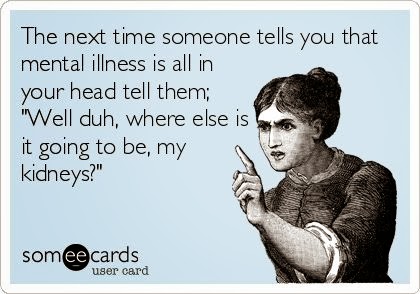
Please take the time to read this article and ask how often do we ask about 'them' and 'their' experiences and don't consider that we are all the same under the skin. I am no less human because of my mental health struggles than I am when I have the 'flu or have a broken bone.

http://www.theguardian.com/commentisfree/2015/apr/05/mental-health-lack-of-empathy-fear-ignorance?CMP=share_btn_fb

Why does my struggle with depression or Personality Disorder warrant less understanding than when I have a bout of the common cold. I get so much sympathy and compassion when I am snuffling, and no one tells me 'You know what you need to do....?'. No, when I am physically ill people consider me as one of 'them' - they will tell me 'this, or that helped me' or they ask me about my symptoms AND they listen to my response with understanding. When anyone dares to talk to me about my mental health, there is often silence when I am honest, followed by a minimisation such as 'Yes I get down sometimes too', or 'You should just shake it off and get out and about.'

The minute our differences start to dehumanise us is the moment when we are given permission to abuse others, just for being 'different' and as history tells us, that is the root of so many atrocities. Tackling stigma of all kinds is so much more than protecting special interest groups, simply because we consider 'them' weak, it is to acknowledge we have a shared humanity. If we are able to recognise our shared humanity then maybe societal scourges such as child abuse, elder abuse, attacks on the disabled and every religiously or ideologically motivated conflict will begin to be eradicated.

Tuesday, 21 January 2014

Fighting the Stigma

Even when meeting people as I leave my hospital appointments, my standard response to the polite, but empty question: 'How are you doing?' is typically either, 'not too bad' or 'fine thanks'. Oh yeah? So why the need to be going to the hospital?

Now, this is most likely partly to do with the cultural norm, I mean no one really means you to tell them how you actually are, do they? How any deviation to this norm is received depends on whether your decision to open up is related to physical health as opposed to mental health. So that, a response of 'Ok apart from this stinking cold' is much preferable to 'Been feeling really down for some time now.' I've been pondering the squeamishness we feel towards discussing mental health. We're different from previous generations, who didn't seem to be aware to any significant degree of emotional or psychological conditions, beyond 'bad case of the nerves', or 'eccentricity' or 'a bit funny'. I'm tempted to laugh, until I realise that actually, reading much recent media coverage, we haven't moved much further on in our understanding and stigmatisation of mental health conditions.

Spurred on by the work of organisations like Mind, Sane, the Black Dog Tribe and campaigns such as Time to Talk, I have been speaking to groups of people, trying to share my experiences of managing a complex mental health condition. I have been encouraged by the number of people for whom this has been a relief. So many people, struggling with depression, anxiety and other mental health conditions feel so, so isolated, because for so long so few people seem to have been able to be open about their own struggles. Again, and again so many have said to me 'I didn't know I wasn't the only one'. 1 in 4 people EACH YEAR suffer from a significant mental health problem ie a condition which requires the support and intervention of GPs, or Mental Health professionals. So if I am talking to 120 people that means that, on average, there will be 30-40 people suffering from a mental health issue at any one time.
Unless a physical illness is destined to be discussed on 'Embarrassing Bodies' I don't think that we are as reticent to discuss our physical ailments. Even then, I think the physical discomfort is likely to drive us to the GP, even men give in to pain discomfort, eventually. In fact, the typical response to telling people about my colds, sniffs, bugs and lurgies is 'Poor you, hope you're looking after yourself', which is nice!

We don't even have an 'Embarrassing Minds' equivalent, because it's easier to just pretend it doesn't exist. On all too rare occasions have I seen TV programmes which provide a small glimpse into something remotely resembling my experience of life, Bedlam, was one excellent example. It is remarkable, sadly, because of its rarity. More frequently, those who have emotional and psychological struggles are portrayed as 'outsiders', 'other than', 'not people like us'. The prime example at the moment is the portrayal of the residents of Benefits Street, most of whom are described in less than glowing terms. Notice the throw away comments about their mental health, such as 'Dee is on ESA because of her depression' dubbed over a scene showing her being narky with her kids. No further explanation of the 'Black Dog' that lives with every sufferer of depression.

I took nearly two years to tell people what I was struggling with Borderline Personality Disorder, (BPD)after I was diagnosed and started on the path to treatment. There were a variety of responses: total denial (Subscript: can't be true, you're too 'normal' and don't appear to be 'unstable'), minimisation (Subscript: No, you're exagerrating surely, why do you need to see a Mental Health Team?), ridicule (Subscript: Always knew you were a 'nutter' ha ha ha), disbelief (Subscript: I can't possibly be friends with someone with a mental health problem!). What all these responses have in common is that they are strategies to distance the responder from the Mental Health condition. If they can make me the 'odd one out' then they can live without fear of 'contagion'.

For people like this I would say: just as much as no one can predict accurately who will suffer from cancer, diabetes, virulent viruses; unfortunately, for us as human beings, we can never predict who is going end up suffering from a mental health problem in the future. In other words: IT COULD BE YOU! That's uncomfortable and bound to provoke anxiety - especially as mental health conditions and how they are managed are so seldom discussed in a well informed way, certainly not in the bulk of the media, or the political sphere.

Until those in charge of the debate, especially those in our government, actually engage in an intelligent and well informed way with the subject, there will be little impetus to improve the portrayal of mental health issues. Thankfully, under pressure from social media and certain individuals and organisations there is a small shift in the debate. However, the most powerful tool in this battle is the true stories behind labels and diagnoses and for this I am grateful to all the campaigning organisations.
Until it is as easy to discuss my mental health, as my physical health, on my better days, I will try to stick my head above the parapet and talk about the part of my humanity 'that dare not speak it's name'.

Saturday, 18 January 2014

Don't forget your laughter muscle...

I'm a bubbly character.

For years, this was a handicap in terms of helping people understand my struggles with Mental Health. I mean, when you suffer from mental illness you're supposed to be 100% miserable all the time - right? Wrong. Just because life is a struggle doesn't mean that we lose our capacity to smile altogether - although there are periods of time when it feels as if life is drained of all colour and enjoyment. And there are moments when it FEELS as if the darkness that envelopes us will never lift. However, the reality of depression and distressing emotions is that they come and go in waves, some are more powerful and overwhelming, others are ripples on the surface of our lives.

Even at my lowest points I have found that I have never lost my wry view of the world and I have found myself laughing my way through therapy sessions focused on some of the most painful experiences of my life. It's a survival technique, one that kept me going through years when I was struggling without any diagnosis or support. Other people's perceptions of Mental Health is such that, due to my propensity to be able to laugh at myself and even the darkest of situations, most people who had contact with me at work or in other social situations would find it hard to accept that I suffered from periods of really black moods, brought on by my struggles with BPD and Clinical Depression. In fact, I lost a number of friends who thought I had taken some bizarre turn in my life when I shared my diagnosis with them. They couldn't reconcile the person they knew with their preconceptions of mental health conditions.


So, now that I'm recovering and am more on an 'even keel' emotionally, do I neglect my sense of humour because I no longer need a mask? My feeling is that my laughter muscle has always been there, it is a part of who I am, but now, rather than being part of my 'armour', it is anchored more and more in my enjoyment of life as it is. I have added it to my DBT skills and use it as opposite action - I mean really, how can I be angry (it used to be white hot and last for hours, if not days on end)when I see myself in the mirror in full flow? Laughter, releases so much tension, in so many situations (caveat: well chosen humour takes account of the needs and feelings of others). Laughing with others, too becomes opposite emotion, so my library of comedy programmes is extensive - an essential part of my 'recovery kit'.

Ultimately, I think that those of us who have seen the world through the prism of mental illness, have the ability to see the quirky and unusual in the world around us. How many comedians struggle with darker emotions? Those of us with BPD are also creative and dramatic, so we are able to see some nuances in life that others miss. When you're in the depths, don't forget your laughter muscle and if something makes you laugh, enjoy the feeling for that moment and observe how your laughter affects you physically as well as your emotions.